
The Commission hosted three virtual public information‑sharing webinars on August 13 and 17, 2026, about our report on offshore oil and gas pipeline leases.
These webinars relate to the Commission’s December 2023 direction (Item 59) for staff to develop an Analysis of Impacts to Public Trust Resources and Values (APTR or Report) for the remaining offshore oil and gas pipeline leases under its jurisdiction. The APTR will assess the risks and impacts of continued offshore pipeline use and will include additional analyses (e.g., related to pipeline integrity, cultural resources, ocean and coastal uses, economic resources, etc.), and it will inform the Commission’s future decisions about these leases.
Frequently Asked Questions
- What is the California State Lands Commission?
- Why is the Commission developing an APTR at this time?
- Will the Commission issue any oil and gas pipeline leases while the APTR is being developed?
- How many pipelines are included in the APTR, and where are they located?
- Which offshore oil and gas pipelines are included in the APTR off of central and northern Santa Barbara County?
- Which offshore oil and gas pipelines are included in the APTR off of southern Santa Barbara and northern Ventura Counties?
- Which offshore oil and gas pipelines are included in the APTR off of Los Angeles and Orange Counties?
- Are there any pipelines excluded from the APTR?
- What is the Commission’s jurisdiction?
- Why are platforms excluded from the APTR?
- Will potential impacts from oil spills be evaluated?
- Will there be consideration of disadvantaged communities in the APTR?
- Will the APTR address the impacts to commercial fishermen and coastal fishing communities?
- What is the timeline?
- Has Commission staff worked with staff from other state and federal agencies on the APTR and will you continue to do so?
What is the California State Lands Commission?
The Legislature created the Commission in 1938 as an independent body composed of the Lieutenant Governor, the state Controller, and the Governor’s Director of Finance. While the Commission has some regulatory functions, it is mainly a land and resource management agency. The Commission manages sovereign public trust lands, which are lands that became state property when California became a state and are held by the state in trust for the people. The Commission manages these lands consistent with the Public Trust Doctrine and in the best interest of the state. The Public Trust Doctrine is a common law doctrine that ensures that sovereign lands are used for public uses, such as commerce, navigation, fishing, recreation, and open space. Public access is a key element of the Public Trust Doctrine because these lands belong to the public. The Commission negotiates leases for the use of these lands.
Why is the Commission developing an Analysis of Impacts to Public Trust Resources and Values (APTR) at this time?
Anticipating the receipt of pipeline lease renewal applications, the Commission wanted an assessment to meaningfully evaluate the risks, economic benefit, public concern, and other factors associated with applications for continued use of offshore oil and gas pipelines. The APTR will essentially serve as an information resource, pulling data from state and federal sources, all intended to aid the Commission’s decision-making with future lease applications.
Will the Commission issue any oil and gas pipeline leases while the APTR is being developed?
No. On October 21, 2026, the Commission extended until December 2027 a temporary moratorium put in place when the APTR was initiated. The temporary moratorium covers the acceptance and consideration of new lease applications involving offshore oil and gas pipelines, and the issuance of new offshore oil and gas pipeline leases.
How many pipelines are included in the APTR and where are they located?
Nine offshore oil and gas pipeline leases covering 19 oil and gas pipelines are included in the APTR. The geographic area spans from Santa Barbara County in the north to Orange County in the south.
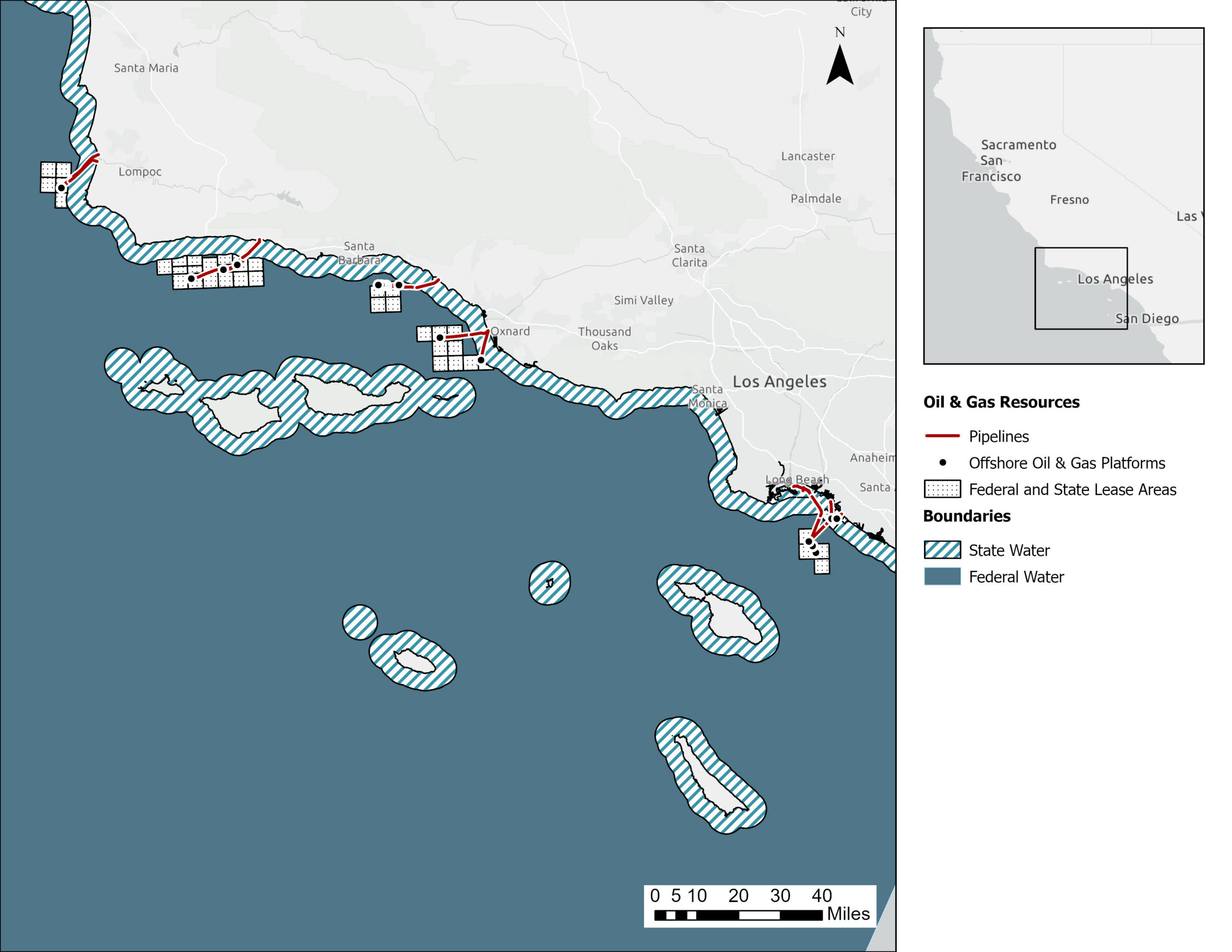
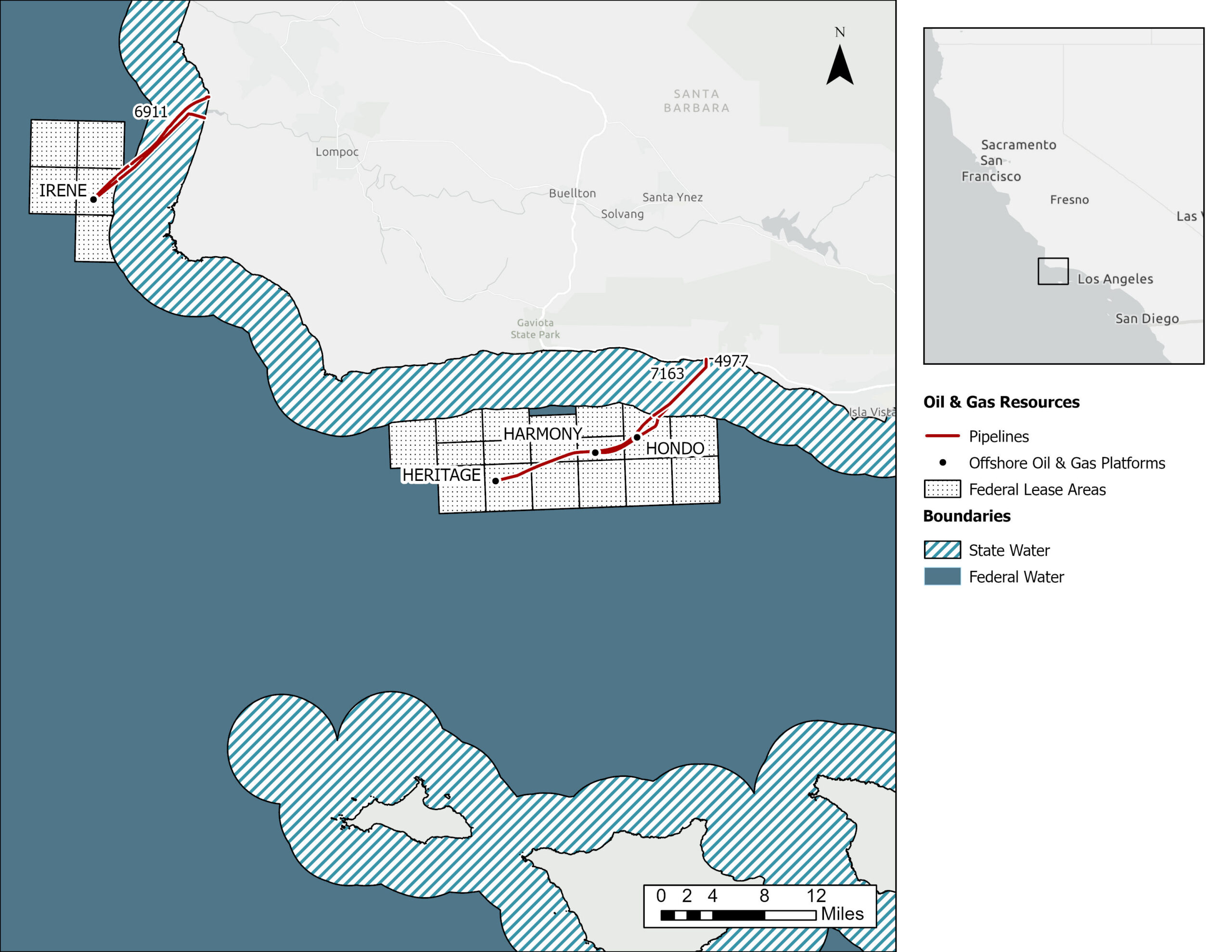
Which offshore oil and gas pipelines are included in the APTR off of Central and Northern Santa Barbara County?
| Lease | Owner/Operator | Servicing Platform | Assets |
|---|---|---|---|
| 6911 | Freeport-McMoRan Oil and Gas/DCOR | Irene | Two oil pipelines; one gas pipeline |
| 4977 | Sable Offshore | Hondo | One gas pipeline |
| 7163 | Sable Offshore | Harmony | One oil pipeline; one produced water outfall |
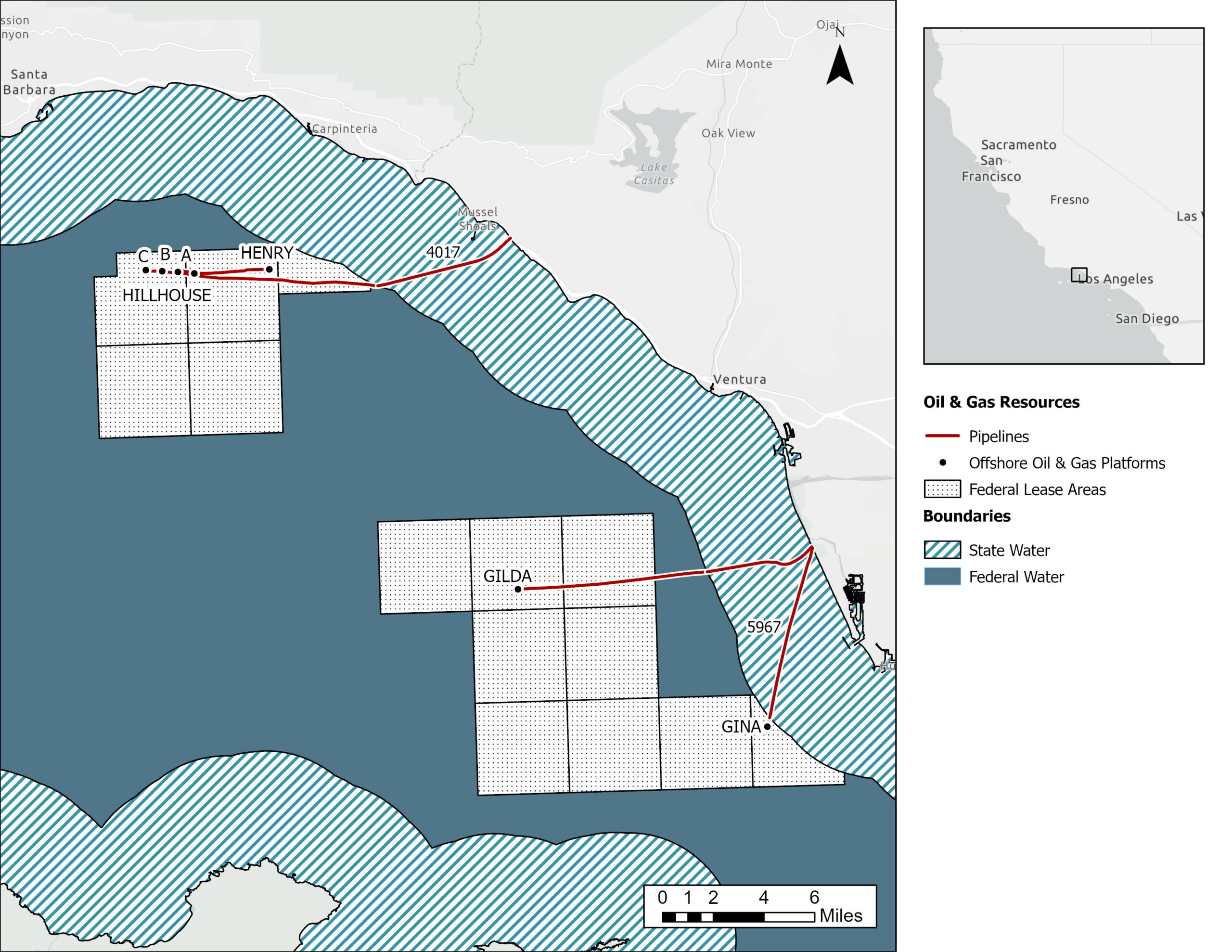
Which offshore oil and gas pipelines are included in the APTR off of southern Santa Barbara and northern Ventura Counties?
| Lease | Owner/Operator | Servicing Platform | Assets |
|---|---|---|---|
| 4017 | DCOR | Platform A | One oil pipeline; one gas pipeline |
| 5967 | DCOR | Gina and Gilda | Two oil pipelines; two gas pipelines |
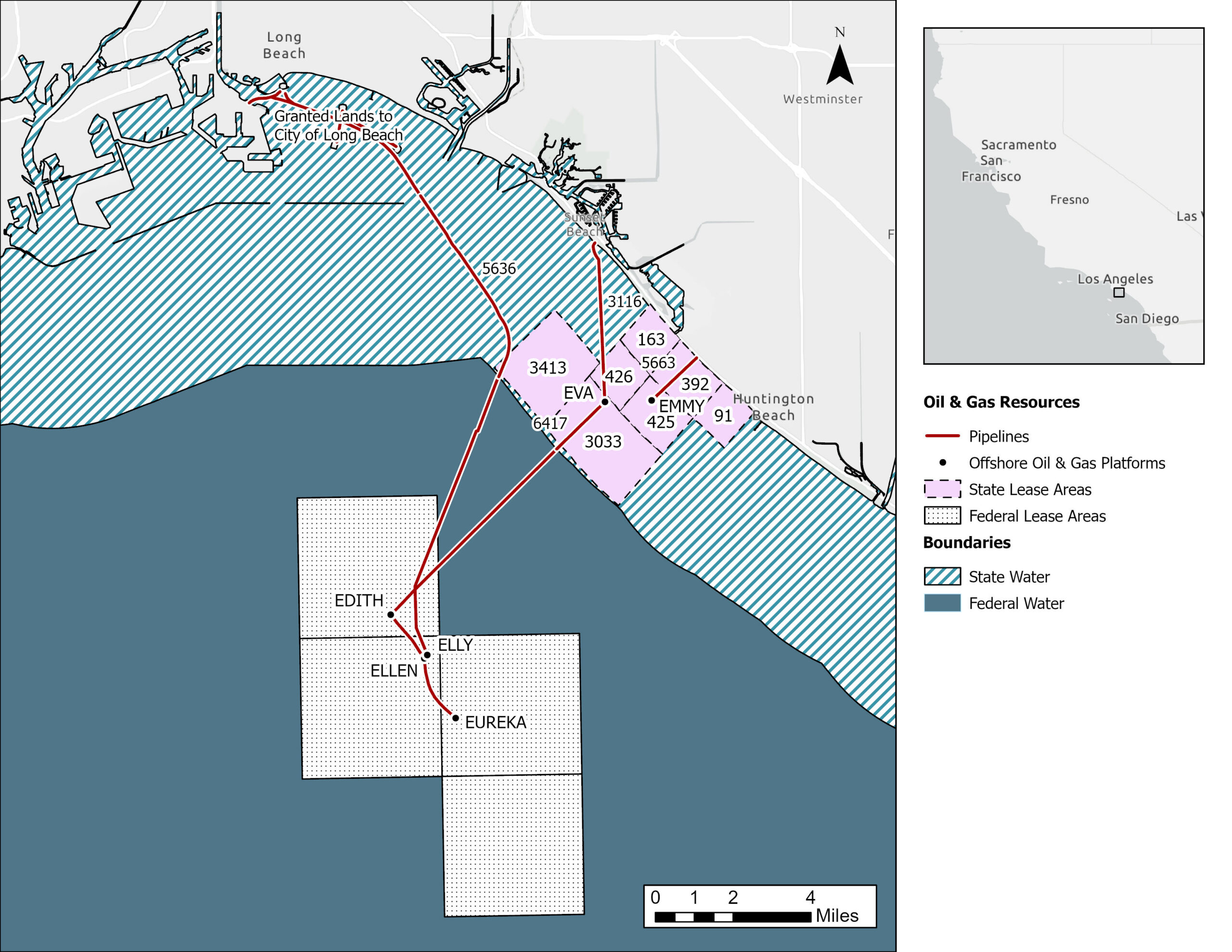
Which offshore oil and gas pipelines are included in the APTR off of Los Angeles and Orange Counties?
| Lease | Owner/Operator | Servicing Platform | Assets |
|---|---|---|---|
| 5636 | Beta Offshore | Elly | One oil pipeline |
| 3116 | DCOR | Eva | One oil pipeline; one gas pipeline |
| 6417 | DCOR | Connects Eva to Edith | One oil pipeline |
| 5663 | CRC | Emmy | One oil pipeline; two gas pipelines |
Are there any pipelines excluded from the APTR?
Yes. The original APTR scope included two leases from Platform Hermosa to shore (Santa Barbara County) and one lease from Platform Esther to shore (Orange County). These leases were subsequently removed from the APTR because the pipelines under these leases have been or are in the process of being decommissioned.
What is the Commission’s jurisdiction?
The Commission has jurisdiction over ocean waters extending from the mean high tide line to approximately 3 nautical miles offshore, the beds of bays and estuaries, and navigable lakes and rivers.
Why are platforms excluded from the APTR?
The platforms are generally excluded from the APTR because all but two are in federal waters (seaward of 3 nautical miles) and are outside the Commission’s jurisdiction. The two platforms in the Commission’s jurisdiction are Emmy and Eva, connected to shore through pipeline lease numbers 5663 and 3116, respectively, and are covered in the APTR. Commission leases for Emmy and Eva were issued decades ago, before California stopped issuing new offshore oil and gas production leases. The Emmy and Eva leases continue to be valid as long as platform production continues.
Will potential impacts from oil spills be evaluated?
Yes. For each lease that contains an oil pipeline, oil fate and transport modeling is being conducted. The spill model will provide detailed predictions of three-dimensional trajectory, fate, biological effects, and other impacts of spilled oil.
In addition to modeling spills from pipelines, spills from potential pipeline alternatives will also be modeled (two hypothetical Southern California spills from importing oil tankers).
Will there be consideration of disadvantaged communities in the APTR?
Yes. The Commission’s Environmental Justice Policy applies to the development of the APTR. The analysis will identify communities at risk of being impacted by the pipelines and that meet the definition of disadvantaged communities (as defined by SB 535, (Chapter 830, Statutes of 2012)). The analysis will evaluate impacts from continued pipeline operations for disadvantaged and underserved communities, including the extent to which proximity to pipeline infrastructure may result in ongoing burdens and whether those communities may be at risk from potential oil spills.
An important aspect of the APTR is that it will describe current environmental and socioeconomic conditions, including how nearby cities and towns have developed and evolved over time. The state looks different now than it did when the leased pipelines were first authorized and constructed. In authorizing this report, the Commissioners instructed staff to assemble the latest information, including that related to underrepresented communities, so future decision-making related to the offshore pipeline leases can be informed by up-to-date information.
Will the APTR address the impacts to commercial fishermen and coastal fishing communities?
Yes, the Ocean and Coastal Uses Subchapter under the Resources Analyses Chapter will describe potential impacts to ocean and coastal user groups, including commercial fishermen. This Subchapter will also discuss potential impacts to the culture of coastal fishing communities.
What is the timeline?
Staff anticipates releasing the draft APTR for public comment in Spring 2027.
Has Commission staff worked with staff from other state and federal agencies on the APTR and will you continue to do so?
Yes. We have and will continue to confer with other agencies to obtain necessary information. However, the APTR’s development is led by the Commission to meet Commission needs, as described in Staff Report 59. Note that agencies are welcome to send questions and thoughts now related to the APTR or provide comments via a more formal process once the draft APTR is released.
Contacts
Amy Vierra or Gordon Huang at CSLC.OffshorePipelines@slc.ca.gov
Or by mail:
California State Lands Commission
Attn.: Amy Vierra
100 Howe Avenue, Suite 100 South
Sacramento CA 95825